Notre Dame Fighting Irish
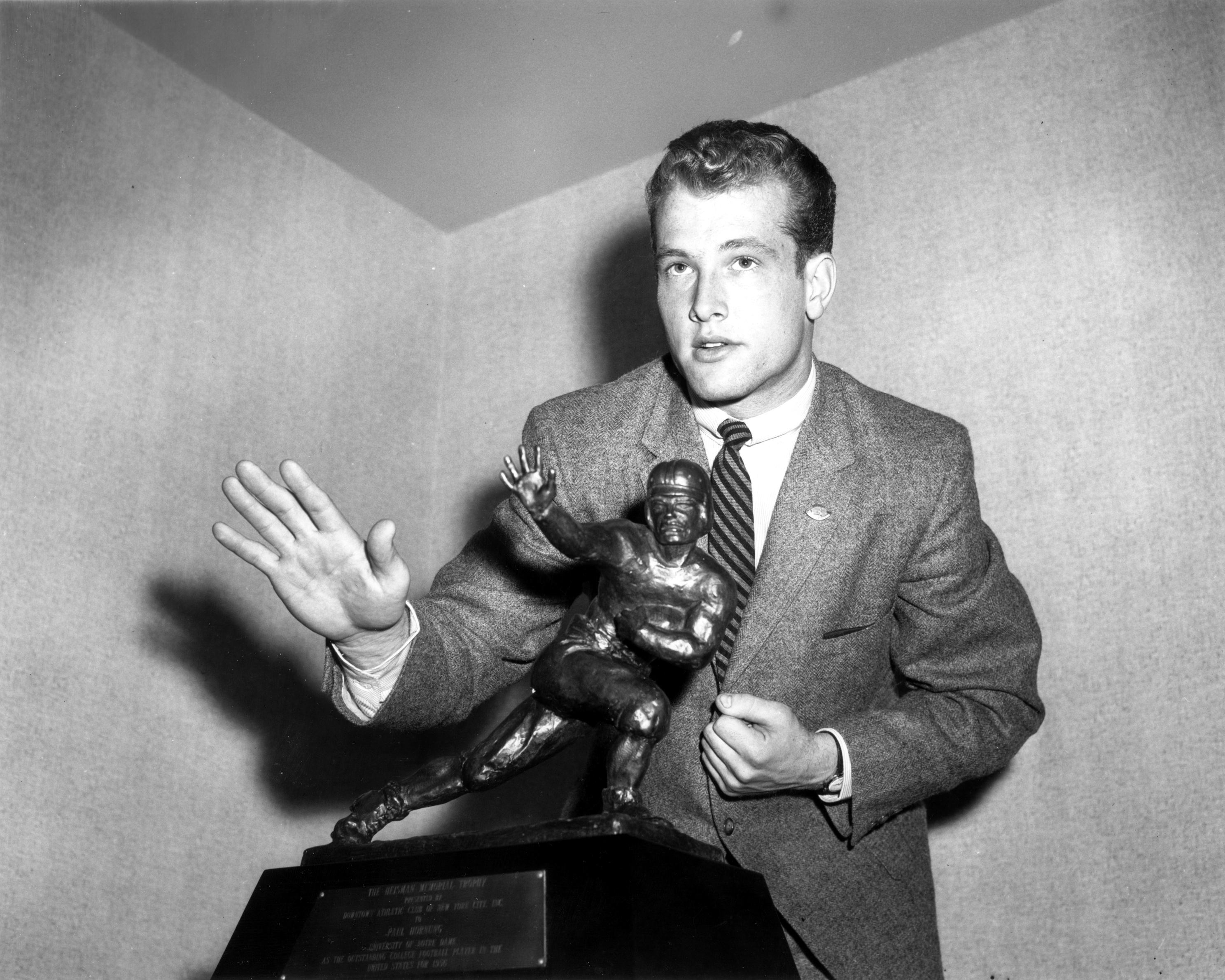
Paul Hornung was recruited to play football at Notre Dame following a stellar three-sport career at Flaget High School in Louisville, Ky. Four years later, he left Notre Dame as a Heisman Trophy winner and two-time All-American quarterback. In 2000, Gannett News Service named Hornung the top quarterback in Notre Dame history.
Hornung quickly made an impression in South Bend. During his freshman spring game, his athleticism and playmaking ability earned him the nickname “Golden Boy” from a Louisville sportswriter—a reference to his golden locks, his golden touch with the football and Notre Dame’s Golden Dome.
As a sophomore in 1954, Hornung played every position in the Notre Dame backfield as a substitute. He also played basketball for the Fighting Irish that season, averaging 6.1 points per game.
Hornung became Notre Dame’s starting quarterback as a junior in 1955 and totaled 1,215 yards of offense, including 743 passing yards and 472 rushing yards. He ranked fourth nationally in total offense and helped lead the Irish to victories over fourth-ranked Navy and Iowa.
His performance against Iowa provided perhaps the clearest early glimpse of the versatility that would define his career. With Notre Dame trailing 14-7 late in the game, Hornung returned a kickoff into scoring position, threw a long touchdown pass, kicked the extra point, kicked off and made a tackle at the two-yard line. He then helped the Irish hold Iowa on defense before returning to quarterback and driving Notre Dame down the field for the game-winning field goal in a 17-14 victory.
Hornung finished fifth in the 1955 Heisman Trophy voting after throwing for 354 yards against USC, the best individual passing performance in the nation that season.
As a senior in 1956, Hornung ranked second nationally in total offense with 1,337 yards and scored a career-high 56 points. He led the Fighting Irish in passing, rushing, scoring, kickoff and punt returns, punting, field goals, extra points and passes broken up. He also ranked second on the team in interceptions and tackles.
In three seasons of varsity football at Notre Dame, Hornung helped the Fighting Irish compile a 19-12 record. He finished his college career with 1,696 passing yards and 12 touchdown passes, 1,051 rushing yards and 15 rushing touchdowns, along with 25 extra points, two field goals, 10 interceptions and 663 yards on 23 kickoff returns.
Hornung was named the 1956 Heisman Trophy winner, becoming the 22nd recipient of college football’s most prestigious individual honor. He remains the only Heisman winner to play for a team that finished the season with a losing record; Notre Dame finished 2-8 in 1956. Hornung also earned All-America honors following his senior season.
His career at Notre Dame established the qualities that would define Hornung as a player: athleticism, intelligence, toughness and an extraordinary willingness to contribute wherever his team needed him. Those qualities would follow him into his professional career and ultimately inspire the creation of the Paul Hornung Award, presented annually by the Louisville Sports Commission to the most versatile player in major college football.